
Standing desk height: how to set a sit-stand desk, and what range to buy
29 October 2026
Height-adjustable desksErgonomicsBuying guide

Two numbers set a sit-stand desk: your elbow height sitting, and your elbow height standing. Standing, bend your elbows to 90° and set the top at or slightly below them. Sitting, the top is level with or slightly above your elbows, feet flat on the floor. UNSW puts a fixed office desk at 710 to 770 mm. Electric height-adjustable desks fit the widest range of people; three of ours run from 620 to 1,270 mm.
What height for sitting?
Sit in your work chair with your feet flat on the floor. Rest your forearms as if on a desk, elbows bent 90 to 100°, shoulders relaxed. Measure from the floor to the underside of your elbow, and write the number down. That is your sitting height: the work surface level with or slightly above your elbows.
UNSW gives 710 to 770 mm for a fixed-height desk, with 720 to 740 mm preferred, citing AS/NZS 4442:2018. RMIT recommends 680 to 720 mm, measured to the top of the work surface. A height-adjustable desk ends that argument: you set it to your own elbow, not to an average.
Then set the monitor. Its top sits at or just below eye level, about an arm's length away.
What height for standing?
Stand up. Relax your shoulders and bend your elbows to 90°, hands held as if on a keyboard. Measure floor to elbow again, and write that number down too. Standing, set the top at or slightly below your elbows, hands on the keyboard. It sits a little lower than your elbows because your forearms slope slightly down to the keys, at an elbow angle of 90 to 95°.
Check the monitor again once you stand: the distance from desk to eye is not the same standing as sitting. Aim for the same monitor and keyboard set-up in both positions.
Standing all day is not the aim. Hold one posture for no more than 20 to 30 minutes, then change, with a minute or two of movement each time. Build standing time up gradually.
What range should a desk cover for a team?
For one person, the desk must reach your two numbers. For a team, it must reach the shortest person's sitting elbow and the tallest person's standing elbow. Body height is no shortcut: the guides give the elbow rule, not a desk height for a person of a given height. So measure the shortest and tallest person's elbows, sitting and standing. It takes a minute each.
AFRDI is the body that tests and certifies office desks against the standard. It says a fixed-height standing desk cannot meet AS/NZS 4442:2018: one height does not fit enough people.
Across our range the lowest top is 575 mm and the highest 1,285 mm. The Klass, AgileMotion and Boost Plus share a 620 to 1,270 mm range; the DUO 402 goes lower, and the Agile Double Motor higher. Each range below is the overall desk height, top included, as its page gives it; the AgileMotion page lists its range without saying. Prices as listed on 29 October 2026.
| Desk | Range and drive | Price and lead time |
|---|---|---|
| Klass Electric Height Adjustable Desk | 620 to 1,270 mm, electric | $799, in stock, flat pack; AFRDI certified, 10-year warranty |
| AgileMotion Electric Height Adjustable Single User Desk | 620 to 1,270 mm, electric | $799, in stock |
| Boost Plus Motorized Height Adjustable Workstation | 620 to 1,270 mm, dual motor, with a screen | $1,220, in stock |
| Agile Double Motor Electric Height Adjustable Individual Desk | 645 to 1,285 mm, dual motor | $1,155, in stock |
| DUO 402 Selectric Height Adjustable Workstation with Screen | 575 to 1,240 mm, two-person pod | $3,495, in stock, lead time 20 to 25 business days, flat pack |
| Boost Crank Single User Manual Height Adjustable Desk | 705 to 1,155 mm, crank | $698, in stock |
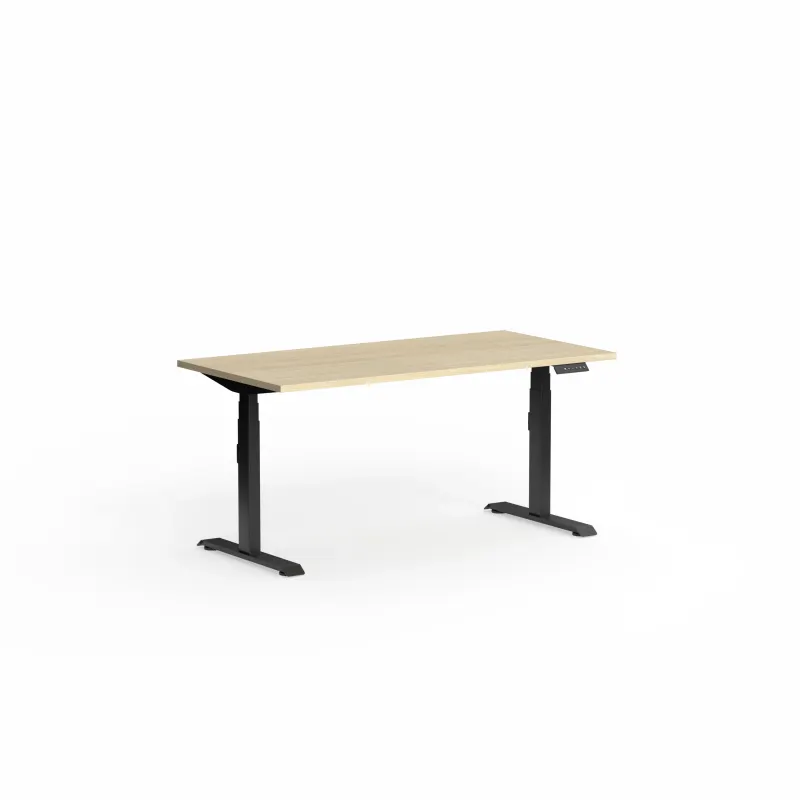
OL Klass Electric Height Adjustable Desk
From $799.00
View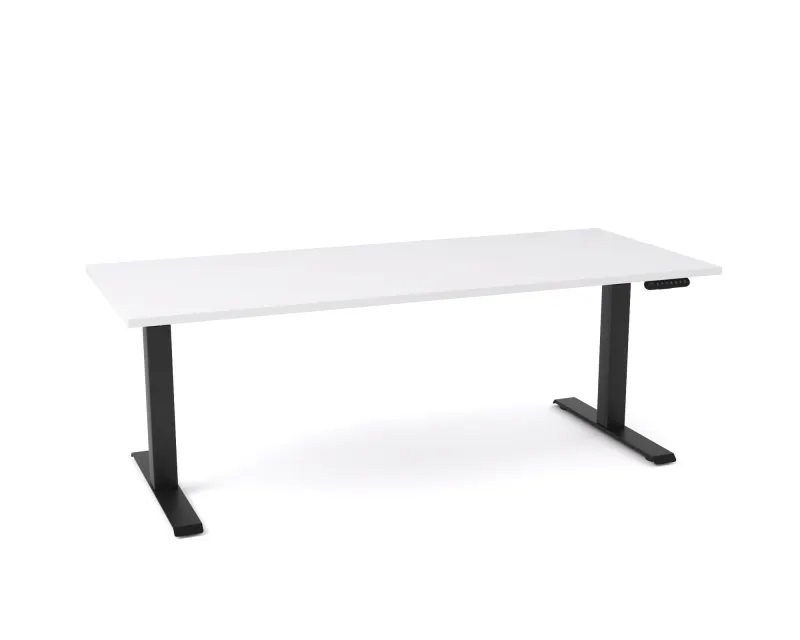
OL AgileMotion Electric Height Adjustable Single User Desk - White Top
From $799.00
View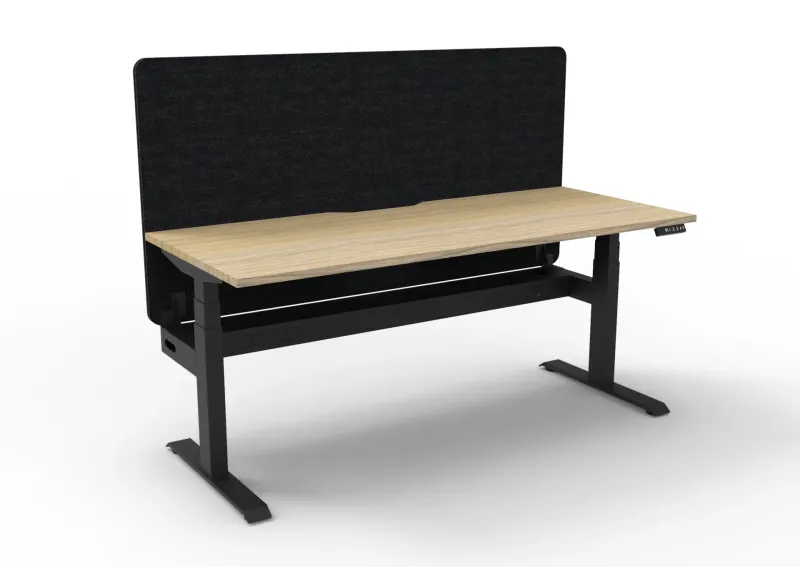
RL Boost Plus Motorized Height Adjustable Workstation with Black Eco Panel Screen
From $1,112.00
View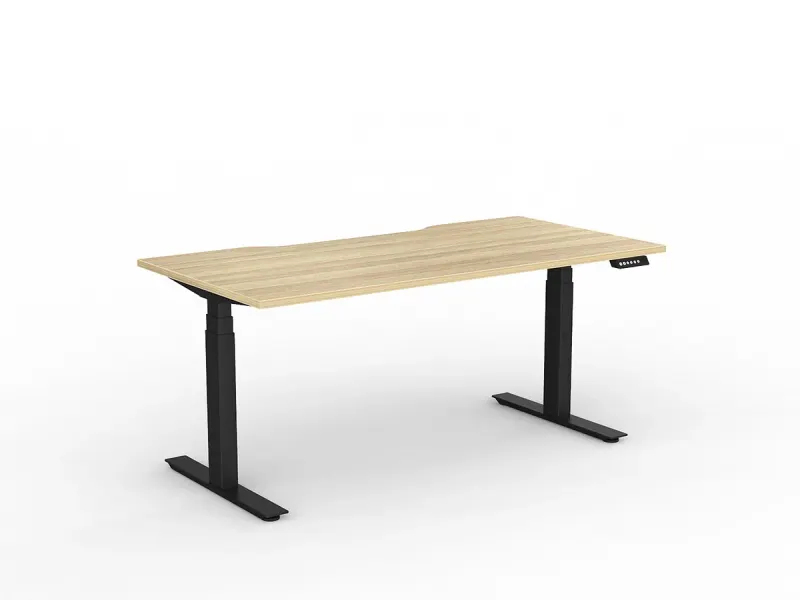
OL Agile Double Motor Electric Height Adjustable Individual Desk
From $1,115.00
View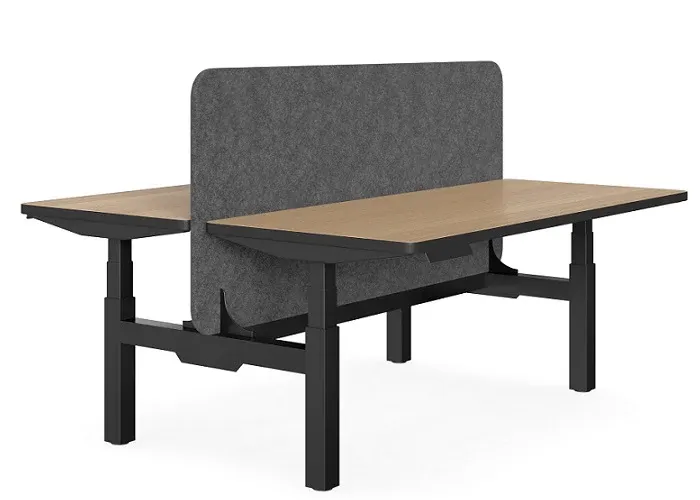
DD DUO – 402 Selectric Height Adjustable Workstation with Screen
From $3,285.00
View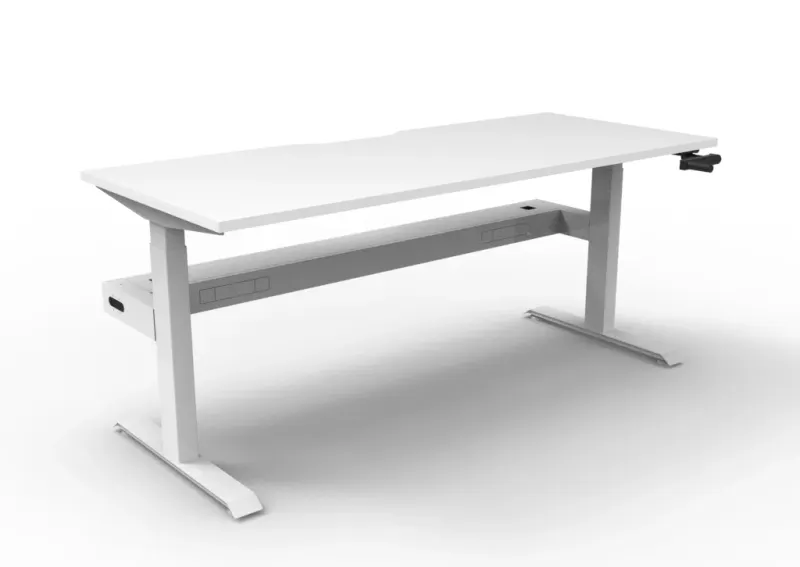
RL Boost Crank Single User Manual Height Adjustable Desk with Cable Tray
From $698.00
ViewThe four single electric desks in the table carry 120 to 160 kg. The Boost Plus moves at 38 mm a second, the Agile Double Motor at 30. The Klass has an anti-collision stop.
Buying ten? Write down the lowest sitting number and the highest standing number in the team, and order the desk that reaches both. Shared desks get the widest range you can, because you do not know who sits there next.
Motor or crank?
Our electric desks move at 25 to 38 mm a second. The crank desk moves at 15 mm a second, 10 mm for each full turn. The Boost Crank runs 705 to 1,155 mm, 450 mm of travel. That is 45 turns of a crank, or 12 to 18 seconds by motor. Several times a day, that decides whether the desk gets used.
Electric height-adjustable desks fit the widest range of people. A height-adjustable desk should carry at least 100 kg, counting the top. UNSW prefers a motor that plugs into the wall over a battery pack, and does not recommend crank desks, because of the repeated winding. Memory positions save the same effort: one press returns the desk to your height. The Klass stores three, the Agile Double Motor four.
If the budget says crank, the Boost Crank suits one person who sets a height and leaves it there most days.
What does the standard cover?
AS/NZS 4442:2018 is the standard for office desks, workstations and tables used as desks. It was published in August 2018 and is still current. It sets minimum requirements for dimensions, general safety, stability, strength and durability. It applies to fixed-height and height-adjustable desks alike, and AFRDI certifies sit-to-stand desks under it, in one of five categories from fixed-height sitting to sit-to-stand. UNSW's reading of the standard also gives a top size: at least 1,200 mm by 600 mm for single-task work. Of the desks above, only the Klass page names AFRDI certification.
The 60-second check
Stand, bend your elbows to 90°, and measure floor to elbow. Sit with your feet flat, rest your forearms, and measure again. Any desk you buy must reach both numbers; for a team, the shortest and tallest person's numbers. Then set the screen top at or just below eye level, and set a timer for 30 minutes.
Measure the people first, then choose from our height-adjustable desks. Many are made to order, with the lead time on the product page. Courier delivery takes 5 to 14 business days once we have processed your order. A custom-made or large, heavy piece goes by professional furniture removal, 7 to 15 business days, at an extra fee. A freight delivery needs a loading dock or a hand to unload; the details are on our delivery page. For a whole office, Plan my office draws a layout from your room size, people and work style. Or send us your product list, floor plan or office size and we will come back with suitable options. Try a desk first at our showroom at 590 Hume Hwy, Yagoona.
The one rule: set the desk to your elbows, sitting and standing, and buy the range that covers everyone who will use it.
Common questions
Is a fixed desk at 720 mm wrong for me?
Not on its own: 720 mm sits inside UNSW's 710 to 770 mm and at the top of RMIT's 680 to 720 mm. It is right when, seated with feet flat, your elbows are level with or slightly above it.
I am tall: which desk reaches?
Measure standing, as above, and buy a desk whose range covers that number. The highest top we list is 1,285 mm, on the Agile Double Motor; the lowest is 575 mm, on the DUO 402 pod.
How long should I stand?
Hold one posture, sitting or standing, for no longer than 20 to 30 minutes, then change. Sitting for more than 30 minutes without a break is likely to be bad for you, and long standing has its own risks. Seated work should still make up most of the day.
Does a monitor arm change the desk height?
No. The desk height comes from your elbows; the screen is set separately, with its top at or just below eye level. Expect to re-set it when you stand.