
Ergonomic office chair checklist: the adjustments to test before you buy
29 October 2026
Office chairsErgonomicsBuying guide

Five adjustments decide whether an office chair fits: seat height, seat depth, back and lumbar height, arm height and tilt. Two checks follow: the base and the rating. Run all seven with the people who will sit in the chair, in our showroom or on a product page, before you pay.
WorkSafe WA's workstation guide sets up the chair first, then the desk, then the screen. Fit the chair before you pick the desk height.
The checklist
| Adjustment | What to test | Pass when |
|---|---|---|
| Seat height | Sit right back, feet flat, hands on the desk | Hips, knees and elbows all sit at about 90 to 100 degrees |
| Seat depth | Sit back until your lower back meets the backrest | Two fingers fit between the seat front and the back of your knee |
| Back and lumbar | Move the back up and down, then lean into it | The curve meets the small of your back |
| Arms | Roll in to the desk with the arms fitted | The arms clear the desk edge and do not press on your elbows |
| Tilt | Lean back in the posture you work in | Steady pressure on your back; it does not push you forward or fall away |
| Base | Push off and roll on the floor it will live on | Five-star base; no tip or slip on your floor |
| Rating | Read the product page | A level or a rated load is printed, and the weight limit covers your heaviest sitter |
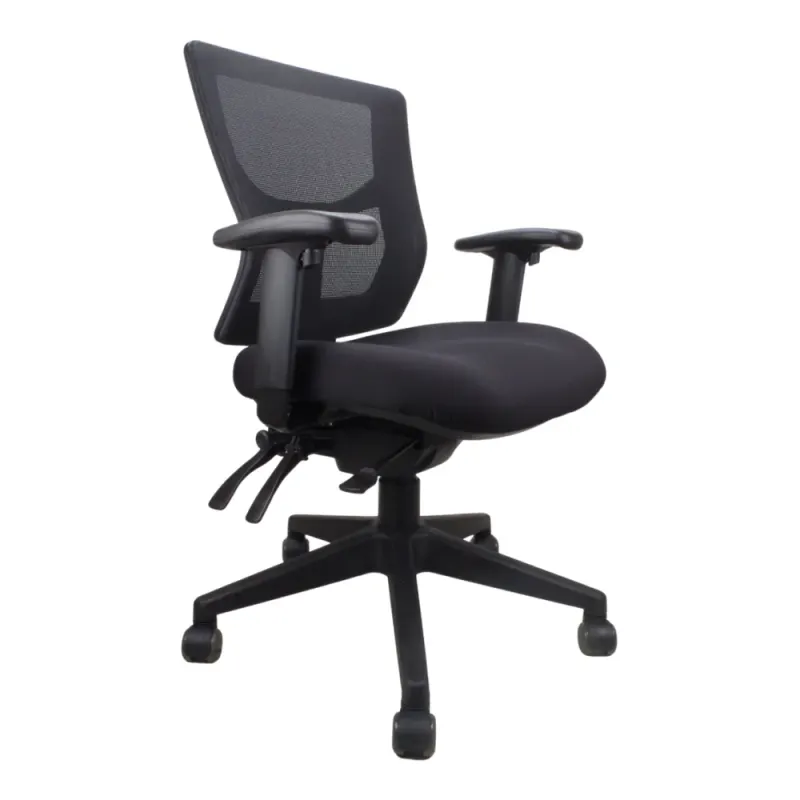
Match the wheels to the floor: castors on carpet, glides or braked castors on a hard floor. The Milan Mesh Back Task Chair comes with 50 mm hard-floor castors.
Not on the list: seat width (sit and see whether the seat edges press on your thighs) and headrest (lean back and see whether it meets your head where you work).
Prices below are as listed on 29 October 2026.
How high should the seat go?
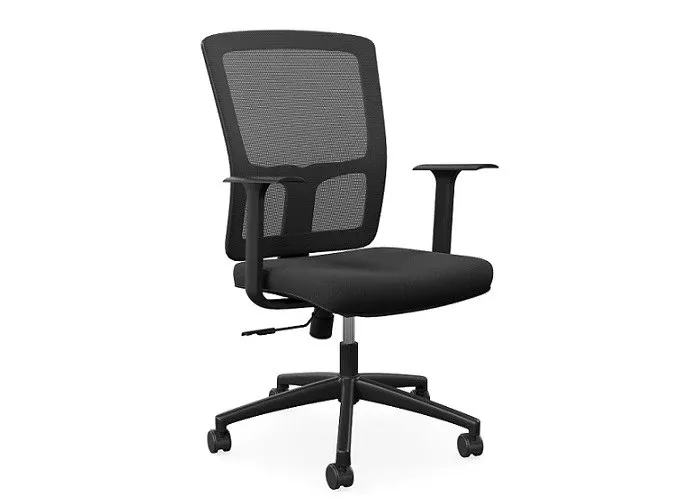
If your feet cannot reach the floor at the right elbow height, add a footrest that adjusts in height and angle. The three task chairs here list seat heights from 435 to 555 mm. The Key Mesh Back Task Chair runs 435 to 535 mm ($258, in stock, 3 to 7 business days). The Milano Mid Back Task Chair with Chrome Base runs 465 to 550 mm ($581, in stock, 3 to 7 business days). The Milan runs 490 to 555 mm ($375, in stock). None of these three covers the whole range, so test the shortest and the tallest sitter, not the buyer.

How deep should the seat be?
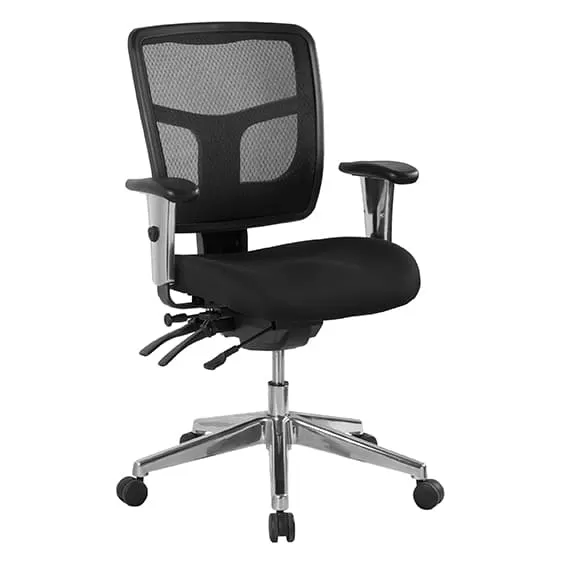
A seat slide changes the depth; a fixed seat does not. Set the seat pan level, or tilted slightly forward. The Milan has a seat slide on its four-lever mechanism. So does the Oyster Multi Shift Low Back Task Chair ($525, in stock, minor assembly required).
Where should the backrest sit?
Set the height first, then the angle. A ratchet back moves in steps; the Milan and the Oyster both have one. The Vogue Medium Mesh Back Task Chair has a height-adjustable lumbar support ($485, in stock). The Impact Multishift Heavy Weight Executive Chair has an adjustable lumbar support too ($1,045, in stock, minor assembly required).
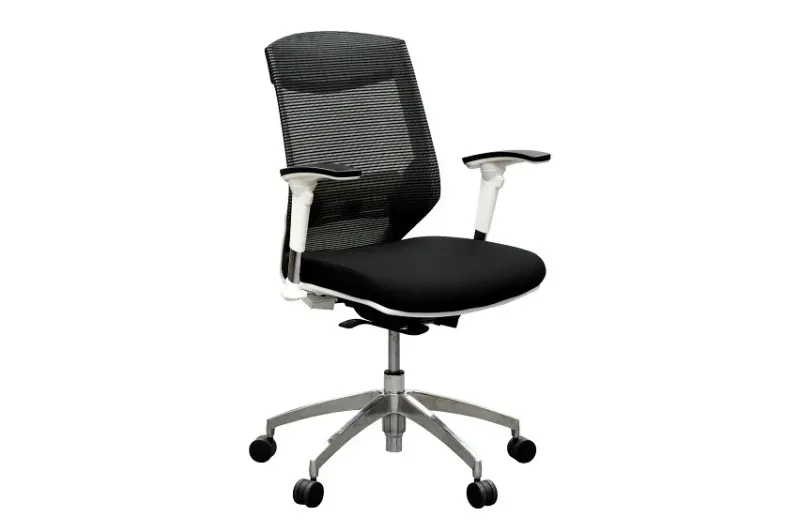
GP Vogue Ergonomic Medium Mesh Back Task Chair
$485.00
View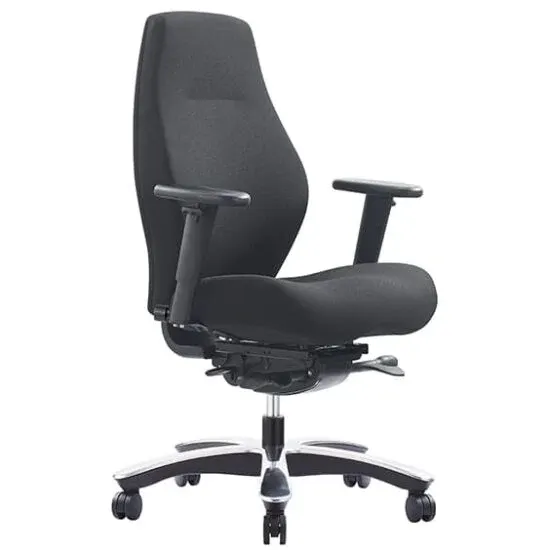
ST Impact Multishift Heavy Weight Executive Chair
$1,045.00
ViewDo I need armrests?
Maybe not. WorkSafe WA does not usually recommend armrests for computer work, unless the arms stay clear of the desk. The Key has fixed armrests. The Vogue has arms that adjust in height and angle. On the Milan, adjustable arms are an extra.
What should tilt feel like?
A lock holds the back where you set it: the Key locks in one position, the Milano and the Vogue in any position. Tension sets how hard the back pushes back. The Vogue sets its tension from the sitter's weight; on the Impact you set the weight tension yourself.
What do AFRDI and AS/NZS 4438 mean?
A rating says how long a chair lasts, not whether it fits. AS/NZS 4438:1997 is the Australian and New Zealand standard for height-adjustable swivel chairs. AFRDI, also called Furntech, is an independent not-for-profit that certifies chairs to the standard at Levels 4, 5 and 6. The tests cover strength, durability, stability, flammability and safety. Level 4 is office and general keyboard use, Level 5 heavy-duty office and industrial use, Level 6 extremely severe use. Furntech says a Level 6 chair will meet most commercial needs, and that the standard suits people up to about 110 kg. Above that, Furntech's own AFRDI 142 Rated Load rates a chair for 135, 160 or 185 kg, single shift or multi-shift. It has no size or fit criteria. A level says the chair lasts; a rated load says who it carries. The number printed on the chair's page is the one that counts. If the level matters for your fitout, Furntech lists every certified chair with its certificate on its website.
How do I choose chairs for a whole office?
For five to fifty chairs, buy one model for most people, not the chair that fits you. Have three colleagues of different sizes run the list on it. Add a second model for your shortest or tallest sitters. The weight limit is the number printed on the chair's page: the Key's and the Vogue's pages each print 120 kg, the Milan's 160 kg, the Impact's 200 kg.
Multi-shift means the chair is sat in for more than one shift a day, well over 40 hours a week, whoever sits in it. One eight-hour shift a day, by day or by night, is single shift. For a desk shared across shifts, look for a chair its maker names multi-shift, such as the Oyster or the Impact. The name is the maker's: the Impact's page says AFRDI tested to Level 6, and the Oyster's page makes no AFRDI claim.
A worked example for 20 chairs. 17 Milan at $375 for most people. 1 Key at $258 for the shortest sitter: 435 mm is the lowest seat here. 2 Oyster at $525 for the two desks sat in over two shifts a day. The Milan's page prints 160 kg and AFRDI Level 6, so the sitter over 120 kg needs no extra chair.
Send us your product list, floor plan or office size through the Add to quote button on any product card. We pick the chairs that fit the brief. For a new office, Plan my office draws the layout from the room size and the people.
Where can I test one?
Sit in one at our showroom at 590 Hume Hwy, Yagoona, Monday to Friday 9:00am to 5:00pm, or Saturday by appointment. Call ahead on 0433 456 880 for a fitout or a bulk order. If a chair comes to you first, decide at the box, not after the Allen key. A change of mind within 14 days needs the chair unassembled and in its original packaging.
Start with our task chairs and mesh back chairs, shortlist three, and bring your shortest and tallest colleague to Yagoona. Five adjustments pass and the rating covers your heaviest sitter: buy it.
Adjust first, admire later.
Common questions
Is a mesh back better than a padded one?
The material does not change the test. Set the back to meet the curve of your lower back and check the pressure in your working posture. The Key, the Milan and the Oyster have mesh backs.
What weight can an office chair take?
The limit printed on its page. Most certified office chairs in Australia and New Zealand are tested to AS/NZS 4438, which Furntech ties to about 110 kg. Above that, look for an AFRDI 142 rated load of 135, 160 or 185 kg. A rated load means the chair is designed for continuous use by people up to that weight. The rating does not say a heavier person who sits on it once will break it.
What if my desk is a fixed height?
Fit the chair first, as the checklist says. If the desk then sits too high, raise the chair by the difference. WorkSafe WA says to set a footrest to the same height.